Why we put a ₹399 price on a free funnel
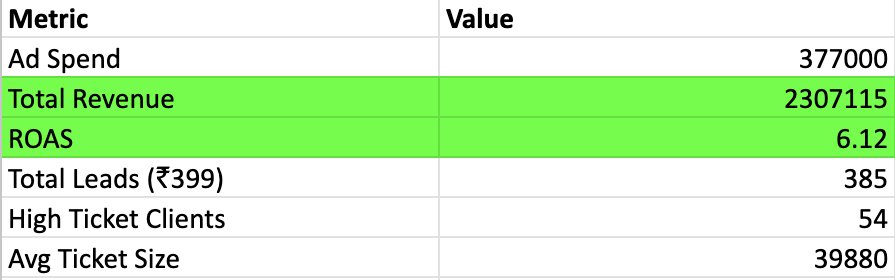
In short: Endo Heal’s India funnel was free, and it attracted people who were curious but not ready. We added a ₹399 entry offer to filter them out. Between August 2025 and March 2026, ₹3,77,000 in Meta ads brought 385 buyers, 54 of whom moved into programs averaging ₹39,880. Revenue: ₹23,07,115. Return on ad spend: 6.12x.
Radhika Jhaveri runs Endo Heal, a coaching practice for women living with endometriosis. When we started, her India funnel did what most coaching funnels do: it gave something away for free and hoped the right people would raise their hand.
Plenty of hands went up. That was the problem.
Free is the most expensive price you can charge
A free funnel looks great on a dashboard. Cost per lead is low, the lead count climbs, and every week there is a bigger number to report. But a lead is not a customer. A lead is a name, and every name costs time: messages, follow-ups, calls with people who were browsing.
For a coach, time is the product. Every hour spent on someone who was never going to buy is an hour not spent on someone who was. The dashboard said the funnel was working. The calendar said otherwise.
What a ₹399 price actually does
₹399 is not a lot of money. That is the point. It is small enough that anyone genuinely looking for help will pay it, and just large enough that people who are only curious will not.
- It filters. Paying anything at all is a decision. People who make it are telling you they are serious.
- It changes the conversation. A buyer arrives having already said yes once. The next conversation starts from trust, not from scepticism.
- It is not a loss leader. 385 entry purchases brought in about ₹1.5 lakh on their own, before a single high-ticket sale.
Where the money is actually made
The ₹399 offer is the door, not the house. Of the 385 people who bought it, 54 went on to join Radhika’s programs, at an average of ₹39,880 each. That is about 14% of entry buyers, and it is where most of the ₹23 lakh came from.
Those 54 conversations happened with people who had already paid, already engaged with the material, and already decided they wanted help. That is a very different sales call from one booked off a free download.
When a paid entry offer is the wrong move
We did not use the same trick everywhere. In Canada and the US, Endo Heal’s audience behaves differently, so the funnel there stayed free and the filtering moved into the form instead. It produced a 93% show-up rate on booked calls. We wrote about that in a separate post.
The lesson is not “charge ₹399”. The lesson is: decide where the filter goes. Every funnel needs one. If the ad doesn’t filter and the form doesn’t filter and the price doesn’t filter, your calendar will.
How to test this in your own funnel
- Count the cost of a bad lead. Not the ad cost. The time: messages, calls, follow-ups. Most founders have never added it up.
- Pick a price that a serious person would not think twice about. It should feel like a formality to a buyer and a barrier to a browser.
- Make the entry product genuinely useful. It has to be worth more than it costs, or the trust it creates turns into resentment.
- Measure the step after. Judge the change by how many entry buyers move into your main offer, not by lead volume.
“You helped me earn money to allow my son to live his dream of being a professional footballer.”
Radhika Jhaveri, founder of Endo Heal
Tell us where your growth is stuck and we will look at your numbers before we reply.